Würzburg lies at about equal distance (120 kilometer, or 75 miles) between Frankfurt am Main and Nuremberg. Although the city of Würzburg is not part of the Landkreis Würzburg, (i.e. the county or district of Würzburg), it is the seat of the district's administration. The city's population was 124,698 as of 31 December 2013.


History
Early and medieval history
A Bronze Age (Urnfield culture) refuge castle stood on the site of the present Fortress Marienberg. The former Celtic territory was settled by the Alamanni in the 4th or 5th century, and by the Franks in the 6th to 7th. Würzburg was the seat of a Merovingian duke from about 650. It was Christianized in 686 by Irish missionaries Kilian, Kolonat and Totnan. The city is mentioned in a donation by Duke Hedan II to bishop Willibrord, dated 1 May 704, in castellum Virteburch. The Ravenna Cosmography lists the city as Uburzis at about the same time.The name is presumably of Celtic origin, but based on a folk etymological connection to the German word Würze "herb, spice", the name was Latinized as Herbipolis in the medieval period.


Beginning in 1237, the city seal depicted the cathedral and a portrait of Saint Kilian, with the inscription SIGILLVM CIVITATIS HERBIPOLENSIS. It shows a banner on a tilted lance, formerly in a blue field, with the banner quarterly argent and gules (1532), later or and gules (1550). This coat of arms replaced the older seal of the city, showing Saint Kilian, from 1570.
The first diocese was founded by Saint Boniface in 742 when he appointed the first bishop of Würzburg, Saint Burkhard. The bishops eventually created a duchy with its center in the city, which extended in the 12th century to Eastern Franconia. The city was the seat of several Imperial Diets, including the one of 1180, in which Henry the Lion was banned from the Empire and his duchy was handed over to Otto of Wittelsbach. Massacres of Jews took place in 1147 and 1298.


The first church on the site of the present Würzburg Cathedral was built as early as 788, and consecrated that same year by Charlemagne; the current building was constructed from 1040 to 1225 in Romanesque style. The University of Würzburg was founded in 1402 and re-founded in 1582. The citizens of the city revolted several times against the prince-bishop, until decisively defeated in 1400.


Modern history
The Würzburg witch trials, which occurred between 1626 and 1631, are one of the largest peace-time mass trials. In Würzburg, under Bishop Philip Adolf an estimated number between 600 and 900 alleged witches were burnt. In 1631, Swedish King Gustaf Adolf invaded the town and destroyed the castle.
In 1720, the foundations of the Würzburg Residence were laid. The city passed to the Electorate of Bavaria in 1803, but two years later, in the course of the Napoleonic Wars, it became the seat of the Electorate of Würzburg, the later Grand Duchy of Würzburg. In 1814, the town became part of the Kingdom of Bavaria and a new bishopric was created seven years later, as the former one had been secularized in 1803 (see also Reichsdeputationshauptschluss).
In 1817, Friedrich Koenig and Andreas Bauer founded Schnellpressenfabrik Koenig & Bauer (the world's first printing press manufacturer).

On the eve of the Nazis' rise to power 2,000 Jews lived in Würzburg, it was a community of tradesmen and professionals. Würzburg was a rabbinic center and home to many Jewish communal organisations and the Jewish Teachers Seminary. In November 1941, the first Jews from Würzburg were sent to the Nazi concentration camps in Eastern Europe. The final transport departed in June 1943. Few survived.
On 16 March 1945, about 90% of the city full of civilians (and military hospitals) was destroyed in 17 minutes by 225 British Lancaster bombers during a World War II air raid. All of the city's churches, cathedrals, and other monuments were heavily damaged or destroyed. The city center, which mostly dated from medieval times, was totally destroyed in a firestorm in which 5,000 people perished.
Main article: Bombing of Würzburg in World War II
Over the next 20 years, the buildings of historical importance were painstakingly and accurately reconstructed. The citizens who rebuilt the city immediately after the end of the war were mostly women – Trümmerfrauen ("rubble women") – because the men were either dead or still prisoners of war. On a relative scale, Würzburg was destroyed to a larger extent than was Dresden in a firebombing the previous month.
On 3 April 1945, Würzburg was attacked by the US 12th Armored Division and US 42nd Infantry Division in a series of frontal assaults masked by smokescreens. The battle continued until the final German resistance was defeated on 5 April 1945.


Geography
Würzburg is located on both sides of the river Main in the region of Lower Franconia in Bavaria, Germany. The main body of the town is on the eastern (right) bank of the river. The town is completely enclosed by the Landkreis Würzburg, but is not a part of it.
Würzburg covers an area of 87.6 square-kilometres and lies at an altitude of around 177 metres.
Of the total municipal area, in 2007, building area accounted for 30%, followed by agricultural land (27.9%), forestry/wood (15.5%), green spaces (12.7%), traffic (5.4%), water (1.2%) and others (7.3%).
The centre of Würzburg is surrounded by hills. To the west lies the 266 metre Marienberg and the Nikolausberg (359 m) to the south of it. The Main flows through Würzburg from the south-east to the north-west.
City structure
Würzburg is divided into 13 Stadtbezirke which are additionally structured into 25 boroughs. In the following overview, the boroughs and their numbers are allocated to the 13 municipals.


Demographics
Würzburg had 124,698 inhabitants as of 31 December 2013.
Economy
Würzburg is mainly known as an administrative center. Its largest employers are the Julius-Maximilians-University and the municipality. The largest private employers are Brose Fahrzeugteile followed by Koenig & Bauer, a maker of printing machines. Würzburg is also the capital of the German wine region Franconia which is famous for its mineralic dry white wines especially from the Silvaner grape. Würzburger Hofbräu brewery also locally produces a well-known pilsner beer.
Würzburg is home of the oldest Pizzeria in Germany. Nick di Camillo opened his restaurant named Bier- und Speisewirtschaft Capri on 24 March 1952. Mr Camillo received the honor of the Italian Order of Merit.


Military
Following World War II, Würzburg was host to the U.S. Army's 1st and 3rd Infantry Divisions as well as an Army Hospital and various other U.S. military units that maintained a presence in Germany. The last troops were withdrawn from Würzburg in 2008, thus concluding more than 60 years of U.S. presence there.


Arts and culture
Notable artists who lived in Würzburg include poet Walther von der Vogelweide (12th and 13th centuries), philosopher Albertus Magnus and painter Mathias Grünewald. Sculptor Tilman Riemenschneider (1460–1531) served as mayor and participated in the German Peasants' War.
Some of the city's "100 churches" survived intact. In style they range from Romanesque (Würzburg Cathedral), Gothic (Marienkapelle), Renaissance (Neubaukirche), Baroque (Stift Haug Kirche) to modern (St. Andreas).
Major festivals include the Afrika Festival in May, the Mozart Festival in June/July and the Kiliani Volksfest in mid-July.


Main sights
- Würzburger Residenz: A UNESCO World Heritage Site, the vast compound near the center of the town was commissioned by two prince-bishops, the brothers Johann Philipp Franz and Friedrich Karl von Schönborn. Several architects, including Johann Lukas von Hildebrandt and Maximilian von Welsch, supervised the construction between 1720 and 1744, but it is mainly associated with the name of Balthasar Neumann, the creator of its famous Baroque staircase. The palace suffered severe damage in the British bombing of March 1945, but has been completely rebuilt. The main attractions are:
- Hofkirche: The church interior is richly decorated with paintings, sculptures and stucco ornaments. The altars were painted by Giovanni Battista Tiepolo.
- Treppenhaus: Here Giovanni Battista Tiepolo created the largest fresco in the world, which adorns the vault over the staircase designed by Balthasar Neumann.
- Kaisersaal: The "Emperor's Hall", the centerpiece of the palace, testifies to the close relationship between Würzburg and the Holy Roman Empire.


- Festung Marienberg is a fortress on Marienberg, the hill to the west of the town centre, overlooking the whole town area as well as the surrounding hills. Most current structures date to the Renaissance and Baroque periods, but the foundations of the chapel go back to the 8th century.
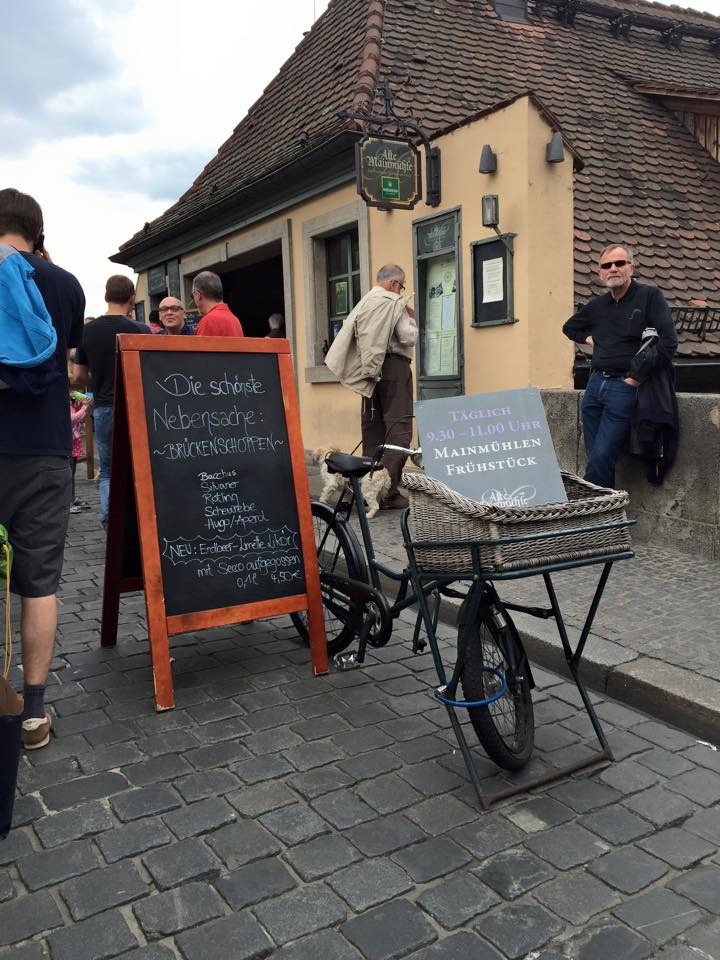
- Alte Mainbrücke (Old Main Bridge) was built 1473–1543 to replace the destroyed Romanesque bridge dated from 1133. In two phases, beginning in 1730, the bridge was adorned with statues of saints and historically important figures.
- Among Würzburg's many notable churches are the Käppele, a small Baroque/Rococo chapel by Balthasar Neumann, perched on a hill facing the fortress, and the Dom(Würzburg Cathedral). The Baroque Schönbornkapelle, a side-chapel of the cathedral, has interior decoration of (artificial) human bones and skulls. Also in the cathedral are two of Tilman Riemenschneider's most famous works, the tomb stones of Rudolf II von Scherenberg (1466–1495) and Lorenz von Bibra (1495–1519). At the entrance to the Marienkapelle (on the market square) stand replicas of the statues of Adam and Eve by Riemenschneider. The Neumünster is a Romanesque minster church with a Baroque façade and dome. Among the Baroque churches in the centre of the city are Stift Haug, St. Michael, St. Stephan and St. Peter.
- The Julius Spital is a Baroque hospital with a courtyard and a church built by prince-bishop Julius Echter. The Julius Spital medieval wine cellar, together with those of the Würzburg Residence and the Bürgerspital are picturesque places to taste the local Frankenwein. The Julius Spital is the second largest winery in Germany, growing wine on 1.68 square kilometres (1 square mile).

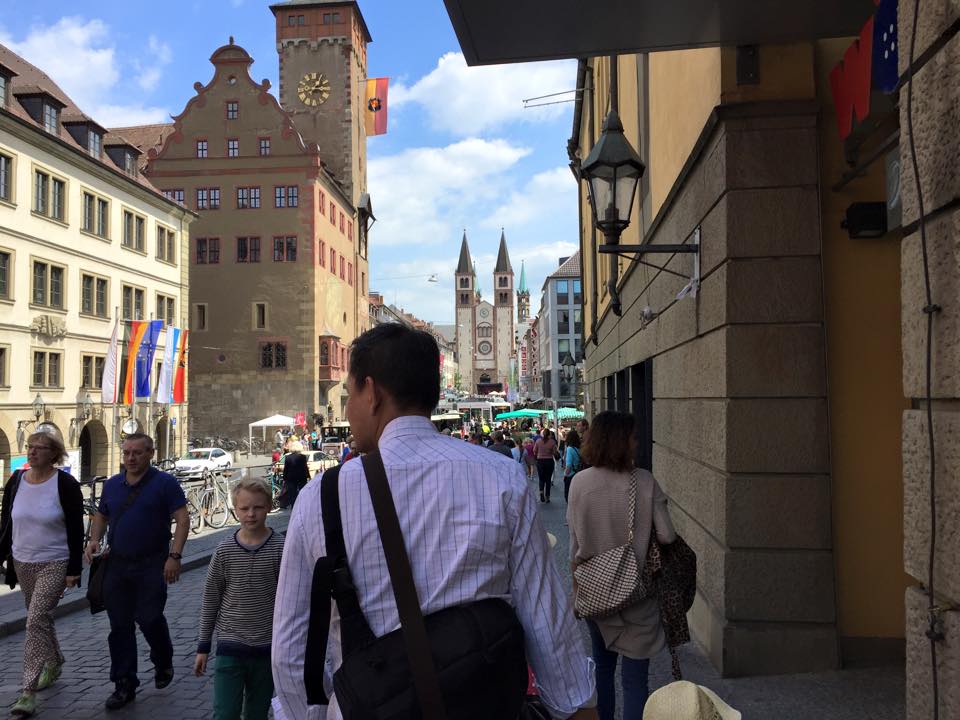
- The Haus zum Falken next to the Marienkapelle, with its ornate façade, is an achievement of the Würzburg Rococo period. Today, it houses the tourist information office.
- The Stift Haug was built in the years 1670–1691 as the first Baroque church in Franconia. It was designed by the Italian architect Antonio Petrini (it).
- The Würzburger Stein vineyard just outside the city is one of Germany's oldest and largest vineyards.


Museums and galleries
- The Mainfränkisches Museum (de) in the fortress is home to the world's largest collection of works by Tilman Riemenschneider. In a space of 5,400 m2 (58,125 sq ft), art by regional artists is exhibited. Exhibitions include a pre-historic collection, artifacts of the Franconian wine culture and an anthropological collection with traditional costumes.
- Fürstenbaumuseum: Also in the fortress, the restored Fürstenbau (former residence of the prince-bishops) houses not only the renovated living quarters, but also an exhibit on the history of Würzburg. Another exhibit features ecclesial gold jewelry and a collection of liturgical vestments. The museum also displays two models of the city: Würzburg in 1525 and Würzburg in 1945.
- Museum im Kulturspeicher, housed in a historic grain storage building combined with modern architecture, has more than 3,500 m² of exhibit space. Collections include the "Peter C. Ruppert Collection", with European Concrete art after 1945 from artists such as Max Bill and Victor Vasarely; works from the Age of Romanticism, the Biedermeier period, Impressionism, Expressionism as well as contemporary art.
- Museum am Dom (Museum at the Cathedral), opened in 2003. It features about 700 pieces of art spanning the past 1000 years. The 1800m2 exhibit contrasts contemporary art with older works.
- Shalom Europe, a Jewish museum. Built around 1504 tombstones discovered and excavated in the old city, the museum uses modern information technology to portray present and traditional Jewish lifestyles and their survival over the past 900 years in Würzburg.
- Martin von Wagner Museum, with objects from ancient Egypt, Greece, and Rome. It is housed in the south wing of the Residenz and displays ancient marble statues and burial objects. There are also ten exhibition halls with art from the 14th to the 19th centuries.
- Siebold-Museum, which houses permanent and temporary exhibits, including the estate of the 19th-century local physician and Japan researcher Philipp Franz von Siebold.


Sports
Würzburg is home to the football teams Würzburger Kickers playing in the 3. Liga and Würzburger FV playing in the Fußball-Bayernliga.
"s.Oliver Baskets" play basketball in the Basketball Bundesliga.
SV Würzburg 05 is a swimming and water polo club, active in the German Water Polo League.
Government
Würzburg is the administrative seat of the Regierungsbezirk Lower Franconia. The administration of the Landkreis Würzburg is also located in the town.
Since April 2014, the mayor of Würzburg has been Christian Schuchardt (de) (CDU).
Education and research
Würzburg has several internationally recognized institutions in science and research:
University
The University of Würzburg (official name Julius-Maximilians-Universität Würzburg) was founded in 1402 and is one of the oldest universities in Germany.
Academic disciplines are astronomy, biology, Catholic theology, chemistry, computer science, culture, economics, educational and social sciences, geography, history, languages and linguistics, law, literature, mathematics, medicine (human medicine, dentistry and biomedicine), pharmacy, philosophy, physics, political science, psychology and sociology.
Today, the ten faculties are spread throughout the city. The university currently enrolls approximately 22,000 students, out of which more than 1,000 come from other countries.
- Wilhelm Röntgen's original laboratory, where he discovered X-rays in 1895, is at the University of Würzburg.
- The University awarded Alexander Graham Bell an honorary Ph.D for his pioneering scientific work.
- The Botanischer Garten der Universität Würzburg is the university's botanical garden.
University of Applied Science
The University of Applied Sciences Würzburg-Schweinfurt was founded in 1971 as an institute of technology with departments in Würzburg and Schweinfurt. Academic disciplines are architecture, business economics, business informatics, civil engineering, computational engineering, computer science, electrical engineering, engineering management, geodesy, graphic design, logistics, mechanical engineering, media, nursing theory, plastics engineering, social work.
With nearly 8,000 students it is the second largest university of applied science in Franconia.
Conservatory
The Conservatory of Würzburg is an institution with a long tradition as well as an impressive success story of more than 200 years. It was founded in 1797 as Collegium musicum academicum and is Germany’s oldest conservatory. Nowadays it is known as "University of Music Würzburg". After the commutation from conservatory to university of music in the early 1970s, science and research were added to complement music education.


